
+ Services · March 2026
Beyond the website: we develop custom digital platforms and solutions
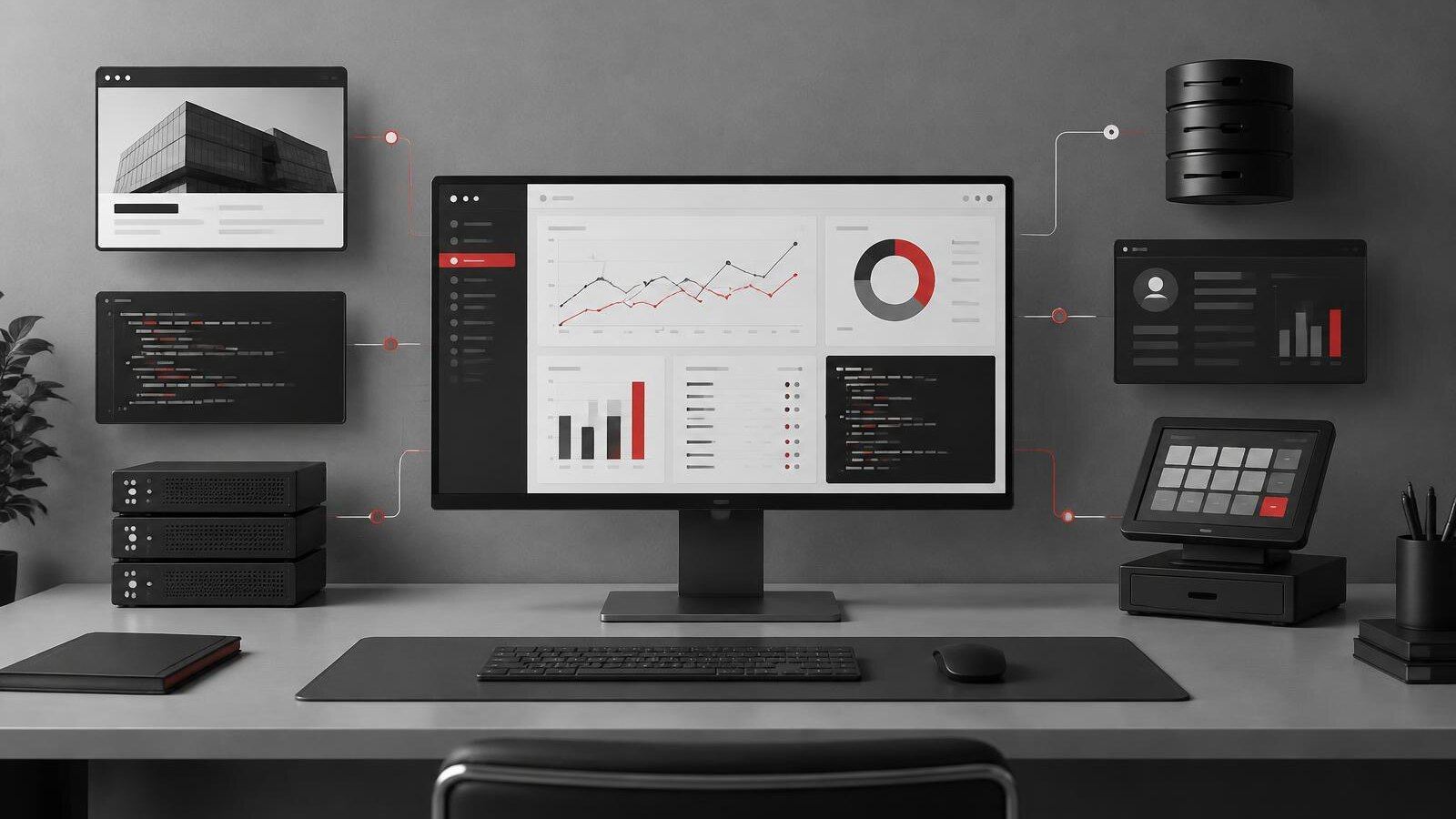
We develop custom platforms, APIs, databases, dashboards, and integrations that connect websites, CRMs, POS systems, and other systems to address real business needs.
Article
Technology can go much further.
When we talk about web development, many people immediately think of a website with a homepage, services, forms, a blog, or an online store. All of that is part of web development, but technology allows us to go much further. Today, it’s also possible to develop platforms, integrations, and custom tools tailored to specific operational needs.
At Alterno, we develop digital platforms, internal tools, integrations, and custom solutions designed around an organization’s actual processes. APIs, databases, and programming allow us to connect systems, organize information, and automate tasks that would otherwise remain separate. Because not all problems can be solved by installing a plugin.
Sometimes you have to build the solution yourself.
+
When Software Has to Adapt to the Business
Many companies end up adapting their processes to the limitations of the platforms they use. They export data from one system, manually transfer it to Excel, and send it via email. Then, someone re-enters the data into another platform, another person prepares a report, and the process starts all over again.
That process works, but it doesn't necessarily work well. A custom-built solution can connect those processes and eliminate unnecessary steps. It can also gather information from different sources, store it, organize it, process it, and present it in a way that is much more useful to the people who actually need to work with it.
That's where development stops being just a website and starts becoming a business tool.
+
Platforms developed to address a need
A custom platform starts with a simple question: What problem do we need to solve? It doesn't necessarily start by asking what software we're going to use. This shift in focus is important because it allows us to understand the process first and then define the appropriate technology.
- Who uses the platform.
- What information is entered.
- What should be done with that information?
- Which users need access.
- What decisions should they be able to make?
- Which other systems need to communicate with it?
- And what results do we need to measure?
Based on those responses, we can design the architecture, user experience, database, and programming needed to build a customized solution. This way, every technical decision addresses a specific need rather than forcing the business to conform to a predetermined tool.
+
APIs: Enabling Different Platforms to Communicate with Each Other
One of the most important capabilities of modern development is integration through APIs, or Application Programming Interfaces. Simply put, an API allows two different systems to exchange information. For a business, this means that a website can connect with other tools that are already part of its operations:
- A CRM
- An inventory system
- A POS platform
- A database
- A payment gateway
- An academic system
- An email marketing tool
- An ERP
- A booking platform
- An authentication system
- Artificial Intelligence Services
- External third-party platforms
Instead of keeping information isolated in different places, we can create connections between systems so that data flows more effectively. These integrations reduce manual processes and allow us to build digital experiences around a connected operation.
A website can go beyond being just a screen and become a gateway to an entire technological ecosystem.
+
Connecting a website to existing systems
It isn’t always necessary to replace the technology a company already uses; in many cases, the best solution is to connect it. One example is the integration we’ve developed between the My CBD Spot website and its point-of-sale platform. The goal of an integration like this isn’t to develop another POS system from scratch, but rather to enable the digital ecosystem to communicate with the tools the business already uses.
This type of connection can streamline processes related to products, inventory, information, sales, or other functions, depending on the capabilities available on each platform. The same principle applies to a wide range of industries. If a platform offers an API or some form of integration mechanism, it is possible to explore how to connect it to other systems.
+
Development of fully custom tools
In other projects, connecting existing platforms is not enough, and the situation requires the development of a custom tool. One example is the Trade Tool for Ferrero Trade Marketing, designed to address specific trade marketing management and operational needs. We also developed Meet Up to support admissions-related processes at the Polytechnic University of Puerto Rico.
For Opti Manufacturing, we developed a CRM-style solution tailored to the organization’s specific processes. For GFR Media, we built a fully customized intranet with Microsoft SSO, organized separately for its various business units and companies. These are brief examples of how a platform can adapt to very different structures, users, and processes without making technology the focus of the story.
Projects and industries may differ, but the logic behind development is similar:
Understand the process, identify the problem, and build technology around the need.
Don't develop technology just because we can. Develop it because it solves a problem.
+
Databases That Really Work for the Business
Behind many custom platforms lies a database, but storing information is only the beginning. What matters is what we do with it and how that information supports operations. A well-designed solution can enable:
- Centralize information
- Create user or customer profiles
- View historical data
- Filter information
- Generate reports
- Assign Tasks
- Change statuses
- Log Activity
- Managing Documents
- Check Permissions
- Create dashboards
- Automate processes
- Send notifications
- Integrate information from other systems
A well-structured database can become the backbone of a digital operation.
+
Dashboards for Turning Information into Decisions
Having data doesn't necessarily mean understanding it. That's why many solutions require an additional layer of visualization through dashboards. A dashboard can organize operational information and turn it into something a user can quickly interpret, answering questions such as:
- What's left to do?
- What happened this week?
- How many applications did we receive?
- What stage are they at?
- Which user performed a specific action?
- Which products or services are driving business?
- Which indicators require attention?
Depending on the project, these visualizations can be automatically updated based on information stored on the platform or received from other systems. The goal is not to display more data, but to present the right information in a way that aids decision-making.
+
Different users, different access levels
Enterprise platforms almost never have just one type of user. Each person logs into the system with different responsibilities and needs:
- There may be an administrator.
- An employee.
- A salesperson.
- A manager.
- A customer.
- A supplier.
Everyone needs to see and do different things. That's why we can develop authentication and permission systems that control:
- Who can enter
- What information can you view?
- What information can you edit?
- What features are available?
- Which actions are logged?
- Which areas of the platform are restricted?
This level of control makes it possible to develop tools that are much more structured than a simple form or a password-protected page. It also helps ensure that each user sees only the information and features relevant to their work.
+
Automation: Fewer Manual Processes
One of the best opportunities when developing a custom solution is to identify repetitive tasks. If a person performs the exact same process ten, one hundred, or one thousand times, it’s probably worth asking whether any part of it can be automated. A workflow can link together various actions that previously required manual intervention:
- A form can automatically create a record.
- That record can be assigned to a person.
- The system can change its status.
- A notification may be sent.
- Another platform can be updated via an API.
- A document can be generated.
- An email sequence can be triggered.
- A conversion may be recorded.
All of this can happen without anyone having to manually copy information between five different systems. Automation does not eliminate the need for oversight; it eliminates repetitive steps so that the team can focus on higher-value tasks.
Technology works best when it eliminates friction.
+
Not everything has to be built from scratch
Custom development doesn't mean reinventing every piece of technology either. In many cases, we use a combination of:
Existing platforms + APIs + databases + custom programming + automation.
We can leverage proven technologies and build only what sets the project apart. This approach can reduce costs, speed up development, and avoid unnecessarily maintaining features that other platforms already handle very well.
The key is knowing what to integrate, what to configure, and what to develop.
+
Websites That Do So Much More
A modern website can serve as the gateway to a much more complex platform. What the user sees on the front end may be only a small part of what’s happening behind the scenes, where the back end connects data, systems, and actions:
- A person fills out an application.
- The system validates the information.
- Save the data.
- It connects them to a database.
- It sends them to a CRM.
- Activate an automation.
- Notify a team.
- Record the lead source.
- And update a dashboard.
For the user, it was simply a click of the "Submit" button. Behind the scenes, there may be an entire technological workflow that organizes the information and immediately triggers the next steps.
+
Technology that can scale with the operation
Another advantage of developing an appropriate architecture is the ability to continue adding capabilities. A platform can start by addressing a specific need and, as the operation evolves, incorporate:
- New Modules
- New Types of Users
- Additional Dashboards
- Mobile Apps
- New APIs
- Automation
- Artificial Intelligence
- New Authentication Methods
- Reports
- Document Processing
- New Databases
This capacity for growth allows us to view development as a platform that can evolve alongside the organization. Scalability ceases to be an abstract promise and becomes an architecture ready to add new features when they are truly needed.
+
Artificial Intelligence as a New Layer
AI is also expanding the possibilities for custom development. A platform can integrate artificial intelligence tools to support tasks such as:
- Organize information
- Analyze documents
- Summarize content
- Search within knowledge bases
- Answer inquiries
- Generate recommendations
- Natural Language Processing
- Identify patterns
- Automate certain tasks
But, once again, AI is a tool. For it to truly generate value, it needs to be properly integrated with existing data, processes, interfaces, and systems. That is why expertise in development, databases, and APIs becomes even more important in this new technological era.
+
From an idea to a working solution
At Alterno, we combine strategy, design, user experience, and programming to develop digital solutions that address real needs. Sometimes the solution is a website or an e-commerce site; other times, we need to connect a website to another platform or develop a dashboard. The scope may include:
- A CRM.
- An internal tool.
- A database.
- A portal.
- An API.
- Or a completely new platform.
We don't start by thinking about technology; we start by understanding the problem. Then we look for the best combination of technology, programming, and integrations to solve it. Developing a custom solution doesn't mean making it more complicated.
It means building exactly what is needed.
+
More than just websites. Digital solutions.
The web has evolved tremendously. Today, a browser can serve as a gateway to extremely sophisticated systems that connect information, people, processes, and platforms around the world. That’s why, when we talk about web development at Alterno, we’re not just talking about creating websites:
- We're talking about the ability to connect systems.
- Develop platforms.
- Working with APIs.
- Design databases.
- Automate processes.
- Integrate existing tools.
- And develop new solutions when what's currently available on the market simply doesn't meet the need.
Strategy + design + technology + programming. All working together to solve real-world problems.
Let's talk
Do you need something that doesn't exist yet?
We can help you design, integrate, and develop a digital solution tailored to your business needs.
REQUEST A QUOTE +Conversation +
Comments.
0 published
Your input helps this conversation grow. Share your comments, questions, or experiences related to this article—we're here to listen.
Be the first to comment.

+ Ideas That Keep Moving Forward
Get the next article.
Creativity, marketing, digital advertising, technology, and artificial intelligence—delivered straight to your inbox.
Tags
Topics in this article.
Continue reading
More from the blog.
Education · May 2025
Websites and the Importance of UX, UI, and Programming
Whether it's a website, microsite, or landing page, web design, UX, UI, and programming are key to making your website connect with visitors and drive sales. Here, we explain what all of this entails and why it's important.
Read the article +Education · September 2026
SEO + AI: How to Prepare Your Brand for the New Era of Search
The way we search is changing. Find out how to optimize your website, content, and brand for Google and the new search experiences powered by artificial intelligence.
Read the article +Opinion · July 2025
Digital Advertising in the Age of Artificial Intelligence (AI)
Artificial Intelligence has transformed marketing and strengthened digital advertising. Google and Meta continue to lead the way in terms of attention, traffic, and purchasing decisions. AI does not replace these channels; rather, it enhances them and improves their efficiency.
Read the article +
Let's get to work