
+ Education · September 2026
SEO AI: How to Prepare Your Brand for the New Era of Search
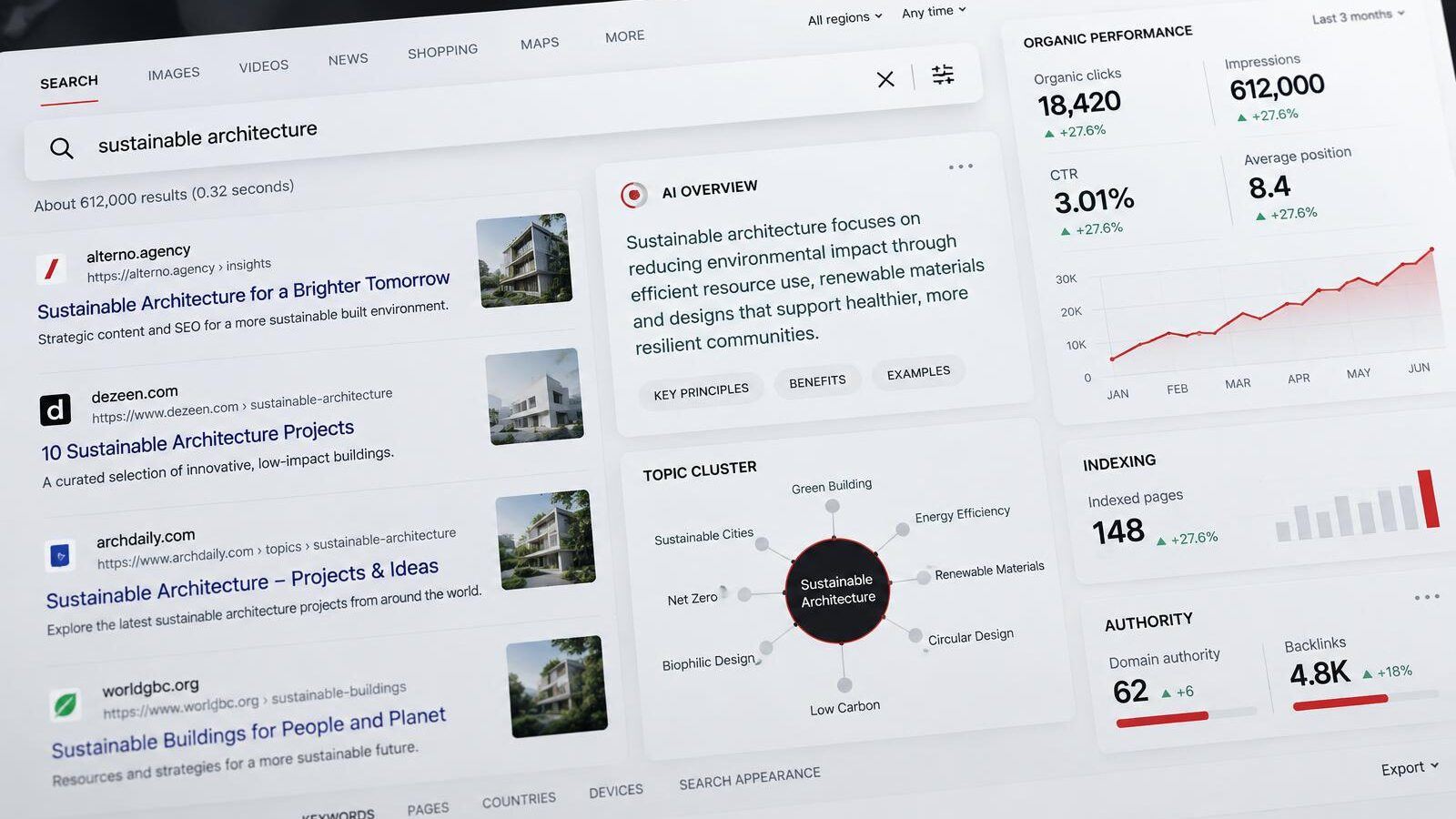
The way we search is changing. Find out how to optimize your website, content, and brand for Google and the new search experiences powered by artificial intelligence.
Article
Search is changing.
For years, whenever we talked about having an online presence, the conversation almost always started with Google.
A person had a need, typed a few words into the search engine, received a list of results, and began browsing websites until they found what they needed.
That behavior still exists.
But now he has company.
In 2026, people are also asking questions directly on ChatGPT, Gemini, Copilot, and other artificial intelligence platforms. Google, for its part, has integrated features such as AI Overviews and AI Mode into its own search engine.
The way we search is evolving.
And that is inevitably changing SEO.
SEO didn't die with the advent of artificial intelligence. It's evolving alongside it.
The question, then, is no longer just:
How do I show up on Google?
Now we must also consider:
How can we make our brand, content, and website easy to find, understand, and use within a search ecosystem powered by artificial intelligence?
Welcome to the new era of SEO.
+
First: What is SEO?
SEO stands for Search Engine Optimization.
In simple terms, it is the combination of strategies, content, and technical adjustments that help a website appear in search results when someone searches for a business, product, service, or topic.
For example, a person might search for:
- advertising agency in Puerto Rico
- engineering universities in Puerto Rico
- screen repair near me
- Best Italian Restaurant in San Juan
- How to Apply for a Mortgage
Behind every search there is an intention.
The role of SEO is to help search engines understand which content can provide a relevant answer to that search intent.
That's why SEO has never been as simple as repeating a keyword twenty times on a page.
Good SEO combines: intent + content + technology + experience + authority.
+
SEO starts before you even begin writing
Before designing, publishing, or planning a campaign, we need to understand what we want to achieve. The same is true for SEO.
Before selecting keywords, we need to understand:
- What the Business Offers
- What Your Audience Needs to Find
- How Do These People Search?
- What questions do they ask?
- What problems are they trying to solve?
- Which competitors are currently in the market?
- What content already exists
- Which pages do we need to develop?
- What action do we want to take after the visit?
Because driving traffic just for the sake of driving traffic doesn't necessarily lead to results.
The goal isn't simply to appear. It's to appear in the right search results.
That's why every project should start with a clear advertising and marketing strategy.
+
Then came Artificial Intelligence
A traditional search usually began with a series of words.
Now we can write or say something much more complex:
“I’m looking for an agency in Puerto Rico that can help me with strategy, Google Ads, social media, and a new website. What should I consider before hiring one?”
That doesn't look like a keyword anymore. It looks like a conversation.
AI-powered search experiences can analyze more complex questions, identify various related topics, and combine information from multiple sources before presenting an answer.
That changes the way we have to think about content.
We should no longer optimize solely for an exact phrase. We need to develop content that truly explains a topic.
+
SEO AI: More Context, Less Obsession with Keywords
Keywords are still important. They help us understand search demand, topics, intent, and language.
But modern search engines are much better at understanding context.
We don't need to fill a page by constantly repeating the same keyword. That doesn't help the user. And it doesn't reflect how modern search engines work either.
The new approach makes a lot more sense:
- Answer the question correctly.
- Explain the topic.
- Provide some context.
- Showcase your experience.
- Organize the information.
- Make it easy to find.
- And it allows both people and machines to understand it.
+
What are SEO, AI, AEO, and GEO?
As is always the case in digital marketing, new acronyms have popped up. Because, obviously, we didn't have enough already.
SEO
Search Engine Optimization. Search engine optimization.
AEO
Answer Engine Optimization. Content optimization for search engines that answer questions directly.
GEO
Generative Engine Optimization. Optimization aimed at improving how content can be integrated into generative artificial intelligence experiences.
We'll also come across terms like AI SEO, LLM Optimization, and other terms that will surely continue to emerge.
Does this mean we need four completely independent strategies?
Not necessarily.
From our perspective, it's more helpful to look at it this way: SEO is the foundation. AI broadens the picture.
+
1. Your website needs to be discoverable and crawlable
Before we talk about AI, we need to talk about something much less exciting: the technical side of things.
If Google can't properly access, crawl, and index a page, all the amazing content you wrote may end up being practically invisible.
This includes elements such as:
- Website Architecture
- Indexing
- robots.txt
- XML sitemaps
- Canonical URLs
- Redirects
- Status codes
- Speed
- Mobile Usability
- JavaScript
- Internal linking
- Metadata
- Security
- Web Hosting
- Performance
Google Search Central provides an official guide to SEO fundamentals to help you understand these elements.
Before AI SEO comes technical SEO. It's not as glamorous. But it works.
+
2. Structure Matters
A website should have a logical hierarchy.
- Homepage.
- Services.
- Individual service pages.
- Products.
- Categories.
- About.
- Cities.
- Frequently Asked Questions.
- Blog.
- News.
- Contact.
Each page should have a clear purpose.
This helps users navigate the site, but it also helps search engines understand how the information is related.
For example, an advertising agency should not list all of its services in a single paragraph on its homepage.
You can have individual pages for:
- Strategy
- Digital Advertising
- Google Ads
- Social Media
- Content Production
- Web Development
- SEO
- Consulting
This allows us to explore each topic in greater depth and build connections between pages through internal links.
Architecture also communicates.
+
3. Write for real questions
Here, AI is creating an interesting opportunity.
People are asking longer, more natural, and more specific questions. That means content can answer equally specific questions.
Not only that: SEO Puerto Rico.
Also:
- How long does it take for an SEO strategy to start producing results?
- What is the difference between SEO and Google Ads?
- Do I need SEO if I already have social media?
- How can my business appear in AI search results?
- What does my website need to rank higher on Google?
Each one represents a different need.
A good website should aim to answer the questions that actually arise during the customer's decision-making process.
+
4. Create original content
AI can generate a huge amount of content. That also means the Internet is being flooded with a huge amount of generic content.
And that's when an opportunity arises.
Having something original to say matters more.
- Personal experience.
- Data.
- Research.
- Cases.
- Results.
- Well-reasoned opinions.
- Examples.
- Processes.
- Comparisons.
- Lessons Learned.
- Experts' Perspectives.
AI can help you research, organize, edit, or create content.
But a company should contribute what AI lacks: its experience.
+
5. Make it clear who you are and what you do
This seems basic. Surprisingly, many companies don't do it right.
Sometimes we visit a website, and even after a few seconds, we still don't know exactly:
- What the company does.
- Where he works.
- Who they work for.
- What services does it offer?
- How to contact her.
- What experience does he have?
In the new search, this is even more important.
Your website should send consistent signals about your company.
- Name.
- Services.
- Location.
- Industry.
- Team.
- Experience.
- Customers.
- Contact Information.
- Social media profiles.
- Contents.
These elements help build a much more comprehensive digital context around the brand.
+
6. The blog is once again playing an important role
The blog never went away. It just stopped being a novelty.
It now plays a particularly important role again because it allows us to explore topics that are difficult to fit into a commercial website.
An SEO page can explain the service. This article can explain our approach to SEO.
One article may answer a question. Another may explore a trend in depth. Another may explain a process. Another may analyze a case.
Little by little, you build an ecosystem of knowledge around your area of expertise.
And each new piece of content can be linked to other pages on the website through internal links.
For example, in “Websites and the Importance of UX, UI, and Programming, ” we explain why user experience and technology remain essential to a digital presence.
Service pages explain what you do. Content demonstrates what you know.
+
7. Structured Data helps organize information
Schema and structured data allow certain types of information to be presented in a structured way that search engines can process.
For example:
- Organizations.
- Products.
- Events.
- Articles.
- Videos.
- People.
- Local businesses.
That doesn't mean that automatically adding schema will make you appear first on Google or that ChatGPT will start recommending you tomorrow.
Nothing works that way.
However, keeping technical information clear and properly structured remains a best practice. Google explains the supported formats in its official structured data documentation.
+
8. Images and video are also part of SEO
Searching no longer means just typing.
We search using images. We watch videos. We use Google Lens. We check YouTube. We interact with multimodal content.
That's why a modern SEO strategy must also take into account:
- Original photographs
- File names
- Alt text
- Video
- Titles
- Descriptions
- Thumbnails
- Context surrounding the media
- Image Optimization
- Performance
Another good example of why SEO can no longer exist in isolation.
Content, design, web development, and SEO need to work together.
+
9. Local SEO remains essential
For many companies, having a global presence matters less than being in the right place.
- A restaurant in Condado.
- A dentist in Caguas.
- A construction company in Puerto Rico.
- A university in Orlando.
- A lawyer in Miami.
This includes elements such as:
- Google Business Profile
- Bing Places
- Location
- Contact Information
- Schedules
- Reviews
- Categories
- Geography Pages
- Local Content
- Consistency of Information
AI doesn't eliminate this component either.
+
10. Authority and reputation still matter
Your website doesn't exist in a vacuum.
What other sources say about your organization also helps build your digital presence.
- Links from other websites.
- Press.
- Reliable directories.
- Associations.
- Universities.
- Partners.
- Publications.
- Interviews.
- Reviews.
- Corporate Profiles.
- Acknowledgments.
All of this is part of the digital ecosystem surrounding a brand.
It's not about getting hundreds of links without context. It's about building a real presence.
Authority isn't something you install with a plugin. It's something you build.
+
11. The information must be kept up to date
A website shouldn't be treated as a project that you launch and then forget about for five years.
- Services change.
- Teams change.
- Products change.
- Schedules are subject to change.
- Prices are subject to change.
- Technology changes.
And the content needs to evolve as well.
This also applies to traditional SEO.
An old page isn't necessarily a bad page. But an incorrect page certainly can be.
+
12. Now we also need to think about visibility within AI
For years, we've used tools like Google Search Console to analyze impressions, searches, pages, rankings, and clicks.
That type of measurement remains essential.
But the ecosystem is evolving, and we're also starting to pay attention to new signals:
- Is our content listed as a source?
- Is our brand mentioned in responses related to our industry?
- Which pages are being found?
- What questions generate visibility?
- What topics are related to our brand?
Before, we mainly asked: What's our ranking?
Now we must also begin to ask:
Can our information be found, understood, and used within AI-powered search experiences?
+
SEO isn't just about traffic
This part is important.
Getting more visitors sounds great. But traffic alone doesn't pay the bills.
An SEO strategy must align with business objectives.
After attracting someone, we need to understand:
- What did he do?
- Did you read the content?
- Have you used our services?
- Did you fill out a form?
- Did he call?
- Did you buy it?
- Have you registered?
- Did you request a quote?
Here, SEO is directly linked to analytics, UX, CRO, and conversion tracking.
Because, at the end of the day, we're not just optimizing a website for robots. We're trying to connect people with solutions.
+
What We Do Not Recommend Doing
Whenever a new technology emerges, shortcuts follow.
- “Do this to appear in ChatGPT.”
- “Install this file, and all the AI systems will find your business.”
- “Publish 500 automatically generated articles.”
- “Say this word, and you’ll appear in AI Overviews.”
You have to be careful.
There is no universal formula that guarantees a brand will appear in an AI-generated response.
Our recommendation is much less spectacular. It's also much more sustainable.
- Build it right.
- Organize things well.
- Write well.
- Explain it clearly.
- Measure.
- Learn.
- Optimize.
+
Our Approach: SEO Integrated into the Entire Ecosystem
At Alterno, we don't view SEO as a list of keywords isolated from the rest of our marketing efforts.
It starts with strategy. We understand the business, its goals, its audience, its competition, and its opportunities.
Next, we'll discuss how they should work together:
Website + content + technical SEO + user experience + analytics + media + technology + data.
If the website needs technical changes, we can handle them.
If we need to develop new pages, we can create them.
If we need articles, we can develop a content strategy.
If we need Google Ads and digital advertising while we're working on organic search engine optimization, we can integrate them.
If we need to track leads, we set up tracking.
And then we use the data to continue optimizing.
It's the same principle we apply to the rest of digital marketing: Planning. Execution. Tracking and Measurement.
+
SEO AI: It's not about starting over
We've seen Google change many times.
Mobile arrived. Voice search arrived. Featured snippets arrived. Visual search arrived. Machine learning arrived. And now, generative search has arrived.
Every change brings about shifts in behavior, formats, and opportunities.
But the premise still makes a lot of sense:
- Build a strong digital presence.
- Post useful information.
- Build technically well-developed websites.
- Understand what the audience is looking for.
- Create original content.
- Build authority.
- And measure results.
Artificial Intelligence adds a new layer.
Now we don't just want our page to appear as a search result.
We also want our information to be discoverable, understandable, contextualized, and—when appropriate—used as a reliable source within new search experiences.
That's SEO in 2026.
Don't chase an algorithm. Build a digital presence that can be found no matter how search evolves.
Let's talk
Is your website ready for the new era of search?
At Alterno, we combine strategy, content, technology, SEO, media, and data to help brands build a digital presence that’s ready to continue evolving.
REQUEST A QUOTE +Conversation +
Comments.
0 published
Your input helps this conversation grow. Share your comments, questions, or experiences related to this article—we're here to listen.
Be the first to comment.

+ Ideas That Keep Moving Forward
Get the next article.
Creativity, marketing, digital advertising, technology, and artificial intelligence—delivered straight to your inbox.
Tags
Topics in this article.
Continue reading
More from the blog.
Services · March 2026
Beyond the website: we develop custom digital platforms and solutions
We develop custom platforms, APIs, databases, dashboards, and integrations that connect websites, CRMs, POS systems, and other systems to address real business needs.
Read the article +Education · May 2025
Websites and the Importance of UX, UI, and Programming
Whether it's a website, microsite, or landing page, web design, UX, UI, and programming are key to making your website connect with visitors and drive sales. Here, we explain what all of this entails and why it's important.
Read the article +Opinion · July 2025
Digital Advertising in the Age of Artificial Intelligence (AI)
Artificial Intelligence has transformed marketing and strengthened digital advertising. Google and Meta continue to lead the way in terms of attention, traffic, and purchasing decisions. AI does not replace these channels; rather, it enhances them and improves their efficiency.
Read the article +
Let's get to work