
+ Education · May 2026
AI in Meta Ads and Google Ads: The New Era of Media Planning and Optimization
How Artificial Intelligence Is Transforming Media Planning, Buying, and Optimization in Meta Ads and Google Ads.
Article
The most significant transformation takes place behind the scenes of the campaigns.
When people talk about Artificial Intelligence applied to advertising, the conversation usually turns immediately to AI-generated images, videos created from prompts, or automatically generated text. This is understandable because that is the most visible aspect of this new technology. However, that is probably not where the most significant transformation is taking place.
On platforms like Meta Ads and Google Ads, artificial intelligence has been working behind the scenes for years, making millions of decisions about which ad to show, to whom, when, where, how much to bid for an impression, and how to allocate a budget to try to achieve a result. What is changing in 2026 is the scale, sophistication, and number of decisions that these platforms can automate.
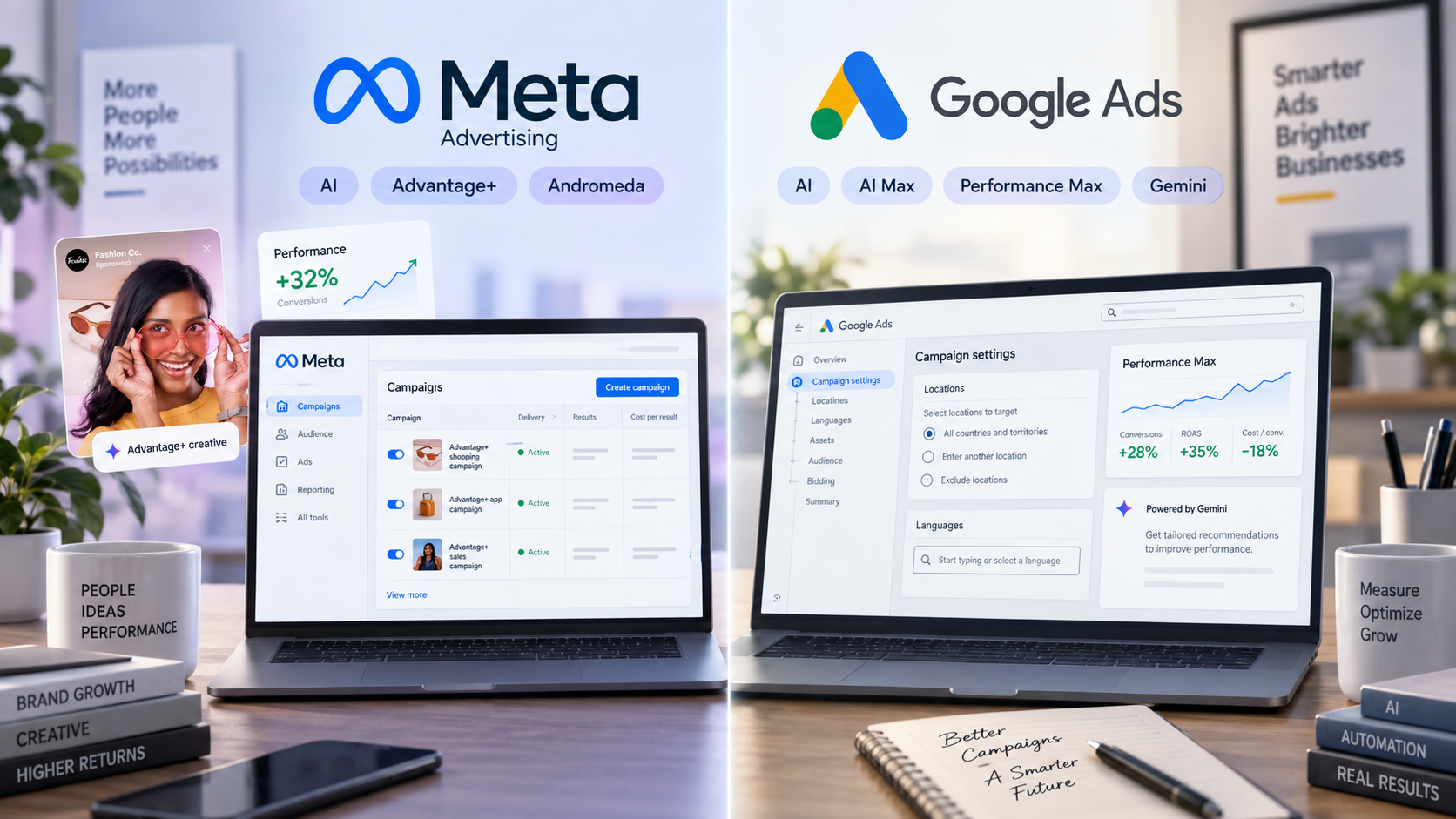
Systems such as Meta Advantage+ and Andromeda, along with Google Performance Max, AI Max, Smart Bidding, and Gemini-powered experiences, are shifting media buying toward a model in which media professionals no longer manually control every variable the way they did a few years ago. This does not mean that strategy is no longer important. It means exactly the opposite: the more operational decisions a platform can automate, the more important it becomes to correctly define what we want that platform to optimize.
+
AI in advertising didn't start with generative AI
Machine learning has long been a part of digital advertising. Google and Meta have been using predictive models for years to estimate the likelihood of clicks, conversions, purchases, views, and many other actions. What’s new is that these systems can interpret an ever-increasing number of signals, evaluate more combinations, and make decisions in real time on a scale that would be impossible to replicate manually.
In the past, a media buyer could create multiple ad sets, segment audiences, choose placements, manage bids, and allocate budget across campaigns. Many of these tasks can now be performed or assisted by artificial intelligence. The goal should no longer be to compete against the algorithm by trying to make thousands of decisions manually that a computer can evaluate in seconds.
The role of the media professional is increasingly shifting toward defining goals, setting budgets, structuring conversions, feeding in positive signals, establishing controls, interpreting results, and deciding what we want the technology to try to achieve. The fundamentals of Google AI Essentials are based precisely on preparing the metrics, first-party data, and goals that drive automation.
+
Meta Advantage: less microsegmentation, more signals
The Meta Advantage+ family of solutions plays a major role in this transition within Meta Ads. Advantage+ automates various components related to audiences, budgets, placements, bidding, and delivery, using machine learning models to identify conversion opportunities within the Meta ecosystem.
For years, a typical Facebook and Instagram Ads strategy might have involved creating multiple manual audiences based on interests, age, behavior, lookalikes, remarketing, and various combinations of targeting. That level of control may still be necessary in certain scenarios, but Meta’s current systems are designed to work with a much broader range of signals and identify opportunities that we might not have identified manually.
The result is a shift in approach. Instead of focusing exclusively on building twenty different segments, it’s becoming increasingly important to ask ourselves whether the objective is properly defined, whether we’re sending the right conversion signals, whether there’s enough budget for the system to learn, whether we’re measuring the right action, and whether we’re giving the algorithm enough flexibility to find opportunities.
+
Andromeda: The Infrastructure Behind Meta Ads
One of the most interesting developments within Meta's advertising system is Andromeda. It is not a button in Ads Manager or a new type of campaign that an advertiser can activate. It is part of the artificial intelligence infrastructure that Meta uses to decide which ads should be initially considered before determining which ones will ultimately be shown to a user.
Meta describes Andromeda as its proprietary machine learning system for ad retrieval. The retrieval stage is the first filter in the ad recommendation system: it narrows down tens of millions of possible ads to a few thousand relevant candidates. Subsequently, more complex ranking models analyze those candidates and determine which ones are most likely to generate value for both the user and the advertiser.
Andromeda uses deep neural networks, hierarchical indexing, and specialized hardware to handle a much larger number of possibilities and detect more complex relationships between people, products, services, and ads. From a marketing perspective, the implication is simple: Meta is increasing its ability to select, from a vast number of possible ads, those that may be most relevant to a specific person at a given moment.
+
What does Andromeda change for an advertiser?
Andromeda does not require advertisers to enable any specific settings, but it does change the way we need to think about strategy. Meta explains that one of the challenges this system aims to address is precisely the exponential growth in advertising options driven by Advantage+ and other automation tools.
This means the platform is equipped to evaluate a wider variety of ads, audiences, products, and signals. From an agency’s perspective, the focus is shifting from telling the algorithm exactly who should see each ad to providing it with clear objectives, conversions, budgets, signals, and constraints so it can identify the best opportunities.
This does not eliminate the audience strategy. It transforms it. Professionals still need to understand who the consumer is, what they need, what results we want, and what information we must provide to the system so that automation works in the business’s favor.
+
Budget: Automation Doesn't Mean Losing Control
One of the main concerns when discussing automated campaigns is the idea that the platform will simply spend the money without any oversight. In reality, the advertiser continues to set budgets, goals, limits, placements, exclusions, and various campaign settings.
What changes is the number of granular decisions the platform can make within those parameters. Meta can identify opportunities across different audiences and placements, while Google can adjust bids in each auction based on the probability of conversion and the estimated value of that conversion.
The conversation around digital advertising and media buying is no longer just about how much we want to spend. We also need to define what results that budget should produce, how much we’re willing to pay per conversion, how much that conversion is worth, whether we want to maximize volume or value, and what CPA or ROAS limits make sense for the business.
+
Google Performance Max: AI Working Across Channels
Performance Max is one of the most comprehensive forms of automation in Google Ads. It is a goal-based campaign type that allows you to access inventory across Search, YouTube, Display, Discover, Gmail, and Maps from a single campaign. Google uses audience signals, conversion goals, budget, assets, and Smart Bidding to determine where opportunities to drive conversions or value exist.
Performance Max doesn't mean that all traditional campaigns have to disappear. Google describes it as a tool that can complement keyword-based Search campaigns, especially when the goal is to find additional conversion opportunities across different channels.
The quality of the results will depend largely on the signals we provide. If all conversions are configured with the same value, Google will optimize based on that assumption. If a low-quality call and a high-value sale count exactly the same, the platform cannot tell the difference unless we communicate it through data and settings.
AI optimizes what we configure, not necessarily what we had in mind.
+
Smart Bidding: Auction-by-Auction Decisions
Behind many Google campaigns lies Smart Bidding, which uses machine learning to automatically adjust bids based on the probability of conversion or value in each auction. This allows the system to take into account signals that would be virtually impossible to process manually at that speed.
The strategic importance lies in correctly defining the outcome we want to achieve. Depending on the business, we can work toward objectives such as maximizing conversions, maximizing conversion value, Target CPA, or Target ROAS. Automation can execute the tactical decision of how much to bid in a specific auction; the agency and the advertiser remain responsible for determining which financial outcome we want to pursue.
+
AI Max: Search Is Evolving
Google is taking this approach a step further with AI Max for Search campaigns. It’s important to note that AI Max isn’t a new, standalone campaign type, but rather an optimization layer that’s applied to existing Search campaigns. Google describes it as a suite of features that uses real-time signals to optimize ad matching, targeting, and delivery.
One of its most important features is the ability to find relevant searches beyond traditional keywords. Google AI Max can combine broad match with asset-based technologies and keywordless systems to identify queries that the advertiser might not have anticipated manually.
This becomes particularly important as searches become longer, more conversational, and more complex. People no longer necessarily type “advertising agency Puerto Rico.” They might search for “an agency that can manage my Google Ads and social media to increase leads for my business.” In this scenario, understanding intent may be more important than relying solely on exact matches—a shift that also aligns with the evolution of SEO and AI Search.
+
AI Max also offers monitoring and reporting features
Automation does not necessarily mean giving up control or transparency. Google has incorporated features into AI Max related to brand controls, locations of interest, URL inclusion and exclusion, search term reporting, and asset reporting.
You can also use Final URL Expansion, where Google selects a page from the website that it considers most relevant to a given search, always within the settings and exclusions defined by the advertiser. This directly connects media and web development.
If landing pages are outdated, poorly organized, or do not accurately represent the business's services, the platform will have fewer good options to choose from. Ad automation works best when the digital infrastructure that powers it is also well-structured.
+
Gemini within the Google Ads ecosystem
Google has also integrated Gemini-powered conversational experiences into Google Ads. These tools can help analyze campaigns, answer questions, suggest optimizations, identify issues, and assist with various setup and creation tasks.
Google describes Ask Advisor as a conversational experience built with Gemini capabilities that can interpret specific questions about an account, analyze performance, help identify issues, and suggest changes that require the advertiser’s approval. An advertising platform is no longer just an interface with tables and metrics; it is beginning to incorporate assistants capable of interpreting some of that information using natural language.
The responsibility for reviewing, interpreting, and deciding remains with humans.
+
The quality of AI depends on the quality of the signals
This is probably one of the most important principles of this entire transformation. Platforms can’t read minds. They learn from the data and goals we provide them. If we want to optimize for quality leads, we need to define what a quality lead means; if we want sales, we have to measure those sales correctly; and if we want to maximize value, we need to identify which conversions generate the most value for the business.
This makes tools such as Google Analytics, conversion tracking, enhanced conversions, Meta Pixel, Conversions API, CRM, and first-party data even more important. The algorithm’s intelligence is no substitute for poor measurement implementation.
We may have extremely sophisticated technology that perfectly optimizes the wrong goal.
+
Automation doesn't mean "set it and forget it"
A campaign that uses artificial intelligence shouldn't be a "set it and forget it" kind of thing. Budgets change, promotions change, the competition changes, landing pages change, and business goals change as well.
Platforms need data and time to learn, but they also need oversight. The difference lies in the type of oversight: less and less micromanagement of small decisions and more and more analysis of strategy, objectives, signals, profitability, and the quality of results.
+
The new media buyer also needs to understand data
Artificial Intelligence is making media, analytics, and strategy even more interconnected. A media professional should no longer limit themselves to looking at CTR, CPC, or CPM. They also need to understand conversions, lead quality, revenue, cost per acquisition, return on ad spend, margin, customer value, and attribution.
The question is no longer just how much the click cost, but rather how much value the investment generated. This shift is particularly important because automated systems require clear economic objectives. If the business can assign different values to different types of conversions, the platform can use that information to optimize in a way that is more aligned with actual priorities.
+
Meta and Google are reaching a similar conclusion
Meta and Google are distinct ecosystems. Meta focuses heavily on discovery, content, behavior, and social environments, while Google continues to hold a unique position in the areas of intent, Search, YouTube, and its broad ecosystem of properties.
However, both platforms are evolving in a similar direction: incorporating more artificial intelligence into targeting, bidding, budgeting, delivery, ad selection, and optimization. Meta uses Advantage+ and internal systems such as Andromeda. Google uses Performance Max, AI Max, Smart Bidding, and tools powered by Gemini.
The names and interfaces may change, but the logic is similar: give the system enough information and flexibility to find opportunities that would be difficult to identify manually at the same speed and scale.
+
What about image and video generation?
Creative generation is also part of this evolution, but from our perspective, it should be viewed as a complementary capability rather than the core of the strategy. Meta and Google continue to introduce features capable of generating, adapting, or expanding advertising assets. These tools can be useful for developing variations, adapting formats, exploring alternatives, and streamlining certain parts of the production process.
However, just because a platform can generate an image does not mean it should automatically replace the professional work of art direction, design, photography, video, or copywriting. A brand needs identity, discernment, consistency, cultural context, and creative direction that accurately represents what it wants to communicate.
At Alterno, we continue to believe in working with designers, photographers, videographers, editors, and other creative professionals. We view generative AI as an additional tool within the process, not as an excuse to eliminate creative judgment.
+
So, what changes for an advertising agency?
For years, a significant portion of the day-to-day work in digital media involved manually performing segmentation, setting bids, managing placements, adjusting budgets, testing different combinations, and making daily adjustments. Many of these tasks are gradually being automated. The work isn’t disappearing; it’s evolving.
An agency needs to focus more and more on understanding what the true business objective is, which conversion we want to optimize, how much that conversion is worth, what budget makes sense, what our CPA or ROAS limits are, what data we’re sending to the platform, and how to interpret the results we receive. We also have to decide which parts we want to automate and which parts require human oversight.
That work is more strategic than just shuffling budgets around every day.
+
Strategy Before Automation
The platform can make thousands of tactical decisions, but it shouldn't be the sole factor in defining the marketing problem. Automation works best when it's based on a clear strategy and well-informed human decisions:
- You can decide where to display an ad, but someone has to define the marketing problem.
- You can optimize for a conversion, but someone has to decide which conversion matters.
- You can adjust the budget, but someone has to determine how much we're willing to invest.
- You can find new audiences, but someone needs to figure out if they make sense for the business.
- It can generate an image, but someone must determine whether it accurately represents the brand.
- It can produce results, but someone has to interpret them.
Artificial Intelligence can make better tactical decisions when we make good strategic decisions.
+
Our Approach at Alterno
At Alterno, we’ve been running digital media campaigns since long before the term “AI” started appearing in every marketing presentation. We’ve seen Google Ads, Facebook Ads, Meta Ads, YouTube, programmatic advertising, retargeting, attribution, and analytics evolve. Now we’re entering a new phase, and our focus isn’t on competing with automation, but on learning how to use it properly.
That means combining strategy, objectives, budget, technology, measurement, optimization, and human judgment. We use the platforms’ artificial intelligence tools when they can help identify opportunities, allocate investment, find audiences, optimize campaigns, or analyze results.
At the same time, we continue to believe that strategy, critical thinking, and professional creativity remain human responsibilities. A platform may decide how best to allocate a budget, but first someone has to decide why we are investing that budget and what outcome truly matters to the business.
Perhaps that is the most significant transformation that AI is bringing about in digital advertising. It’s not simply that machines are taking on more tasks; rather, they are forcing us to focus more on what requires judgment: defining the problem, setting the goal, measuring the right metrics, and interpreting the results to make better decisions.
Let's talk
Is your media strategy ready to take advantage of AI?
At Alterno, we combine strategy, media, technology, and data to leverage the new capabilities of Meta Ads and Google Ads with clear objectives, accurate measurement, and human judgment.
REQUEST A QUOTE +Conversation +
Comments.
0 published
Your input helps this conversation grow. Share your comments, questions, or experiences related to this article—we're here to listen.
Be the first to comment.

+ Ideas That Keep Moving Forward
Get the next article.
Creativity, marketing, digital advertising, technology, and artificial intelligence—delivered straight to your inbox.
Tags
Topics in this article.
Continue reading
More from the blog.
Education · September 2026
SEO + AI: How to Prepare Your Brand for the New Era of Search
The way we search is changing. Find out how to optimize your website, content, and brand for Google and the new search experiences powered by artificial intelligence.
Read the article +Education · April 2025
Key Metrics and KPIs in Digital Media Explained
Digital media makes it possible to measure everything in real time. Here, we explain the essential metrics and KPIs that every organization needs to understand in order to optimize its strategy and make data-driven decisions.
Read the article +Opinion · July 2025
Digital Advertising in the Age of Artificial Intelligence (AI)
Artificial Intelligence has transformed marketing and strengthened digital advertising. Google and Meta continue to lead the way in terms of attention, traffic, and purchasing decisions. AI does not replace these channels; rather, it enhances them and improves their efficiency.
Read the article +
Let's get to work