
+ Services · August 2026
Is your business ready for the holiday season and online sales?
Get your e-commerce business in Puerto Rico ready for Black Friday and Christmas: payments via ATH Móvil, local shipping, promotions, gift cards, inventory, analytics, and strategies to boost online sales.
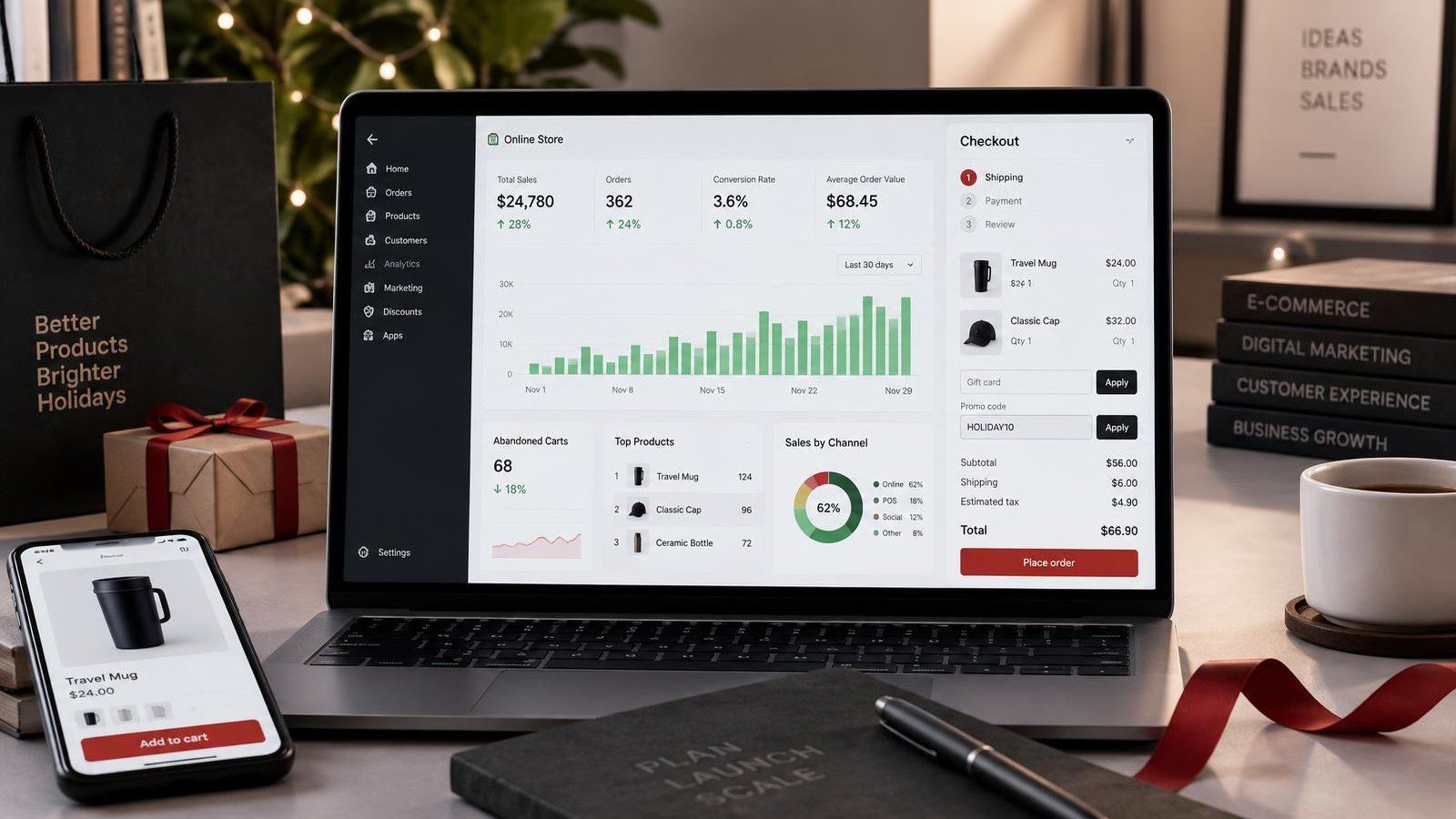
Article
Selling online requires a well-established ecosystem.
It’s that time of year again: Black Friday, Cyber Monday, sales, gifts, last-minute shopping, deliveries, pickups, and ads everywhere. Every year, more of this activity takes place online, and for many businesses, the holiday season is one of the most important sales periods of the year. But it can also be a pretty intense test of their entire digital ecosystem.
Because it's one thing to have an online store, but it's quite another to be truly prepared to sell when demand increases.
Is your business ready for the holiday season and online sales?
We're not just talking about having products listed. We're talking about the website, inventory, payments, promotions, advertising, analytics, customer service, logistics, and technology all working together.
+
The pandemic accelerated a trend that was already underway
E-commerce existed long before 2020, but the pandemic dramatically accelerated that shift. For months, online shopping ceased to be merely a convenient alternative and became, in many cases, a necessity. People who had never shopped online began to do so, while businesses that had never sold online had to learn quickly.
Restaurants implemented digital ordering, stores began offering delivery or curbside pickup, and small business owners started selling directly through Instagram, Facebook, WhatsApp, and other platforms. Many of these changes are here to stay. Today, online shopping is no longer an experience reserved for large retailers; it’s part of everyday life.
+
It's never been easier to start selling online
One of the major changes in e-commerce is that the barrier to entry has dropped significantly. Years ago, creating an online store might have required a complex programming project and a considerable investment. Today, anyone can start selling using platforms like Shopify, WooCommerce, or even much simpler tools like Facebook Marketplace.
You can come up with an idea, source or manufacture a product, take photos of it, post it online, promote it, and start receiving orders. That’s extraordinary: technology has democratized e-commerce. But it has also created much more competition, because if it’s easier for you to sell online, it’s just as easy for thousands of other businesses.
The question is no longer just whether you can sell online. The question is:
Why should they buy from you?
+
Black Friday is no longer just one Friday
For years, Black Friday was mainly a single day. Today, it’s almost a season within a season: sales start earlier, followed by Black Friday, Cyber Monday, Cyber Week, December shopping, last-minute gifts, gift cards, and post-Christmas sales. Afterward, the exchange and return periods begin, along with shopping using cash or gift cards received during the holidays.
That's why getting ready for Christmas doesn't mean putting up a sign that says "20% OFF" on the Wednesday before Black Friday. The preparation starts much earlier.
+
In Puerto Rico, holiday e-commerce has its own rules
Although many of this season’s trends are global, selling online in Puerto Rico has a local context that’s worth understanding. Puerto Rican consumers blend the digital and the local in a very unique way: they discover products on Instagram or Facebook, ask questions on WhatsApp, compare prices on Google, pay with ATH Móvil, and often prefer to pick up their purchases in-store rather than wait for delivery.
There’s also a frustration that almost every local consumer is familiar with: reaching the checkout page of a U.S. store and discovering that “they don’t ship to Puerto Rico,” or that they treat the island as an international destination. For businesses here, that frustration is an opportunity: a Puerto Rican online store can offer faster local shipping, in-person pickup, payments via ATH Móvil, and customer service in Spanish and English—all within the buyer’s time zone.
The calendar is also different. In Puerto Rico, the holiday season doesn't end on December 25: after Christmas come the "Octavitas" and Three Kings Day on January 6, which for many families means another round of gifts, gift cards, and shopping. This extends the local holiday shopping season by several weeks longer than in other markets.
In addition, the “buy local” movement continues to grow: more and more consumers are actively seeking out products made in Puerto Rico and Puerto Rican businesses for their holiday gifts. An online store that clearly communicates that it is a local business—where it is located, how it delivers, and how customers can pay—starts with a trust advantage over any out-of-state retailer.
For Puerto Rican consumers, shopping at a local business that has a strong online presence offers the best of both worlds: the convenience of e-commerce combined with the confidence that comes from buying locally.
+
First: Does your store actually work?
It sounds obvious, but before you spend a single dollar on advertising, make a purchase yourself in your store. Do it on your phone and walk through the process from start to finish: search for a product, go to the product page, select a variant, add it to your cart, apply a discount, and calculate shipping costs. Fill in your information, select a payment method, complete the purchase, and confirm that you receive the corresponding notification.
Now ask yourself a few questions:
- Was it easy?
- Was it quick?
- Was there ever a time when you weren't sure what to do?
- Did you have to fill out too many fields?
- Did the discount codes work?
- Is the shipping clear now?
- Did the confirmation arrive correctly?
- Was the experience just as good on mobile?
During the holiday season, every extra step can create friction, and that friction can lead to an abandoned shopping cart.
+
Mobile first. Seriously.
Much of the digital experience begins on a phone. A user might discover your product on Instagram, watch a Reel, see an ad, search for you on Google, open your website, and make a purchase—all without touching a computer. That’s why a store that works perfectly on desktop but feels clunky on mobile has a problem.
Check:
- Button size
- Navigation
- Menus
- Photographs
- Variants
- Shopping Cart
- Checkout
- Forms
- Payment Methods
- Speed
- Pop-ups
- Promotional Codes
Don't design the mobile experience as a scaled-down version of the desktop site. Design with how people actually shop in mind.
+
Payment options also drive sales
One of the major changes in modern e-commerce is the number of payment options available. Credit and debit cards remain essential, but depending on the platform, location, merchant, and eligibility, there are now also alternatives such as:
- Apple Pay
- Google Pay
- PayPal
- Shop Pay
- Klarna
- Affirm
- Buy Now, Pay Later
- ATH Mobile Business in Puerto Rico
Not all methods are suitable for every business, and each platform has different requirements, costs, and terms. But the principle is simple:
The fewer obstacles a customer encounters when paying, the better the experience will be.
The way you prefer to get paid isn't necessarily the way your customer prefers to pay.
+
What if the customer wants to pay later?
This is where options known as “Buy Now, Pay Later” (BNPL) come into play. For certain products, allowing a buyer to pay in installments can make a purchase more affordable. This can be particularly relevant during the Christmas season, when people are likely buying several gifts within a short period of time.
Tools like Klarna and Affirm allow eligible merchants to offer installment payment options or financing under their respective terms. This doesn't mean that every business needs BNPL, but it does mean that payment strategy deserves to be evaluated as part of the shopping experience.
Checkout is also a form of marketing.
+
You can also sell gift cards online
Gift cards have become a particularly useful tool during the holiday season, and today many e-commerce platforms allow businesses to sell them directly from their websites. This opens up a significant opportunity for businesses that may not sell traditional physical products.
- A store.
- A restaurant.
- A spa.
- A living room.
- An experience.
- Professional service.
- A class.
- A study.
- A brand of products.
A gift card can lead to a digital sale even when the buyer doesn't yet know exactly what they want to give as a gift. It also helps solve one of the classic Christmas problems:
“I don’t know what to buy him.”
From a business perspective, a gift card can:
- Generate revenue during the season
- Attract new customers
- Make last-minute gift-giving easier
- Reduce reliance on physical inventory
- Generate future visits or purchases
- Allow special promotions
- Selling Even When the Business Is Closed
When the platform allows it, the process can be entirely digital. The customer makes a purchase, receives the card or code, and shares it with someone else. The recipient then uses it online or in-store, depending on the merchant's settings.
At Christmas, a gift card is also a product.
+
Deals and coupons: Not everything has to be 50% OFF
The holiday season is also a time to think strategically about promotions, discounts, and digital coupons.
Modern e-commerce platforms allow you to create promotions that are much more flexible than simply manually changing a product's price.
You can develop:
- Discount Codes
- Automatic Discounts
- Discount percentages
- Fixed amounts
- Free shipping
- Buy One, Get One
- Bundles
- Gifts with Purchase
- Volume Discounts
- Promotions by Category
- Exclusive offers for select customers
- Early access
- Coupons for email subscribers
- Online-only promotions
- Offers with an expiration date and time
This allows you to create different promotions for Black Friday, Cyber Monday, Christmas, or even specific customers.
For example:
- 20% off everything in the store.
- Free shipping on orders of $75 or more.
- Buy two and get a third one free.
- $15 off purchases of $100 or more.
- Early access for registered customers.
- A free gift with purchases of a certain amount.
You can also create campaign-specific coupons: one code for use only on Instagram, another sent via email, one for existing customers, and another for influencers or partnerships. This not only encourages purchases; it can also help you understand which promotion or channel is driving results.
+
But an offer also has to make sense for the business
Here's something we shouldn't forget: selling more doesn't always mean making more money. An aggressive discount may increase orders, but it can also significantly reduce the margin.
Before launching a promotion, we should consider:
- Product Cost
- Margin
- Shipping
- Payment Fees
- Platform Costs
- Advertising spending
- Discounts
- Operating Costs
Sometimes, a free shipping threshold can yield better results than lowering the price of all products. A bundle can increase the average order value, a free gift with purchase can better protect your profit margin, and an additional gift card can encourage a future purchase.
The best promotion isn't necessarily the one with the highest discount percentage. It's the one that motivates consumers while still making sense for the business.
+
Set up and test the coupons before publishing them
This may seem like a minor issue until hundreds of people visit the website and the Black Friday code doesn't work.
Before launching a campaign:
- Try each code.
- Confirm the dates.
- Check the time zones.
- Check for excluded products.
- Check the minimum purchase amounts.
- Confirm whether the discounts can be combined.
- Check to see what's happening with products that are already on sale.
- Test the code on a mobile device.
- And make a real test purchase.
A promotion that doesn't work at checkout isn't a promotion. It's a customer service issue waiting to happen.
+
A major advantage of e-commerce: you can measure just about everything
Here's one of the most important differences between simply selling a product and running a true e-commerce operation: a website allows you to measure performance. With proper implementation of analytics and conversion tracking, we can understand a large part of the customer journey.
For example:
- How many people visited the store?
- Where did they come from?
- What campaign led them there?
- What products did they see?
- Which categories did they visit?
- Which product did they add to the cart?
- How many started the checkout process
- How many completed a purchase
- Which products generate the most sales?
- What is the average order value?
- Which Promotions Work Best
- Which campaigns generate revenue
- How many customers return?
Tools like Google Analytics, Google Ads, Meta Pixel, and e-commerce platforms themselves can help us connect advertising, behavior, and sales. That completely changes the conversation, because we no longer have to rely solely on:
“I think the campaign worked.”
Let's begin our analysis:
What actually drove sales?
+
And what about abandoned shopping carts?
A customer visited your store, found a product, added it to their cart, and maybe even started the checkout process, but didn't make a purchase. That's an abandoned cart, and it doesn't necessarily mean that sale is lost forever. Analyzing these carts can help us identify important issues.
For example:
- Do people abandon their carts when they see the shipping cost?
- Does the checkout process have too many steps?
- Is a payment method missing?
- Is there a technical error?
- Is the promo code not working?
- Do consumers simply need more time to make a decision?
Depending on the platform and the relevant permissions, we can use automations to try to recover a portion of those purchases. For example:
- Abandoned Cart Emails
- Reminders
- Remarketing
- Advertising Audiences
- Specific Incentives
- Tracking Viewed Products
- Checkout Automation
A customer may abandon their cart today and complete the purchase tomorrow after receiving a reminder. During Black Friday and Christmas, when consumers compare multiple products and stores at the same time, this can be particularly important.
An abandoned shopping cart is also a source of information.
It helps us understand where we're missing out on opportunities.
+
Chat and Chatbots: Providing Support While the Customer Makes a Decision
During the holiday season, many purchasing decisions are made in a matter of minutes. Customers are comparing prices, products, delivery dates, and payment methods, and a single unanswered question can be enough to send them to another store. That’s where live chat and chatbots become a sales tool—not just a customer service tool.
A live chat feature on the website allows us to answer questions in real time that would otherwise result in visitors leaving the site:
- Do you have this product in stock?
- If I order today, when will it arrive?
- Do you ship to my area?
- Can I pay with ATH Móvil?
- Do you have gift cards?
- What is the deadline for ordering before Christmas?
When staff are unavailable, a chatbot can continue the conversation: answer frequently asked questions, direct visitors to the correct category or product, collect their contact information, and follow up later. Today’s platforms allow you to automate responses regarding hours of operation, shipping policies, returns, and availability, and escalate the conversation to a human representative when the issue warrants it.
The key is to set it up with the same level of care as the rest of the store: clear answers, up-to-date seasonal information, and a clear path to speaking with a human when necessary. A poorly configured chatbot causes just as much frustration as a phone line that no one answers.
During peak season, every question answered in a timely manner is a sale that didn't go to the competition.
+
Retargeting: Keeping the Conversation Going with Undecided Buyers
The reality of holiday e-commerce is that most visitors don’t make a purchase on their first visit. They see the product, compare it, keep it in mind, discuss it with someone, and may return. Retargeting—or remarketing—exists precisely for this behavior: it allows your brand to remain visible while the undecided shopper makes up their mind.
With pixels and audiences set up correctly, we can reconnect with people who have already shown interest:
- People who visited the store
- People who viewed a specific product
- People who added items to their cart but didn't buy anything
- People who started the checkout process
- Past customers to whom we can present new products or gift cards
This allows for campaigns that are far more relevant than a generic ad: showing someone the product they were looking at, reminding them that the offer is about to expire, letting them know the shipping deadline, or presenting them with an alternative within the same category. During Black Friday and Christmas, when consumers are receiving ads from dozens of brands at the same time, that relevance makes a huge difference.
Retargeting also helps make better use of advertising spend, because we don't rely solely on finding new customers; we also focus on people who are already familiar with the brand and are closer to making a purchase. Tools like Google Ads and Meta platforms allow us to build these audiences and measure their impact on actual sales.
An undecided buyer isn't a lost sale. It's a conversation that isn't over yet.
+
Lead nurturing: Turning Interest into Trust
Retargeting works for people who visited your store, but what about those who left you their contact information? Anyone who signed up to receive a guide, downloaded a catalog, filled out a form, subscribed to your mailing list, or started a chat conversation is a lead. And those leads are probably the people most likely to buy from you this season.
That's where lead nurturing comes in: the process of maintaining a useful and relevant conversation with these people—at the right time and with the right content—until they're ready to buy. It's not about sending them aggressive advertising or bombarding them with offers; it's about systematically building trust with the right message at the right time.
The difference between retargeting and nurturing is subtle but important: retargeting reminds people who have already seen your content; nurturing gives them reasons to stay interested. Retargeting focuses on the advertising audience; nurturing focuses on building relationships, typically through email, WhatsApp, SMS, and content, complemented by retargeting campaigns.
A well-nurtured lead doesn't need to be convinced in December. By the time December rolls around, they're already convinced.
+
An example: How to nurture a lead through December
Let's say a business is just getting started now, with the holiday season approaching. Here's a simple step-by-step guide to how lead nurturing can prepare a prospect to make a purchase this Christmas:
- September — Lead Generation: A person downloads a seasonal guide, signs up to receive offers, or provides their email address in exchange for a coupon. That first point of contact turns an anonymous visitor into a real lead.
- October — Value: Instead of selling right away, you share useful content: gift ideas, tips, new arrivals, and blog posts. The goal is for the brand to be visible and seen as trustworthy—not just as another store.
- Early November — Teaser: Announce that something big is coming: “This season, we’ll have special offers for our subscribers.” Building anticipation before Black Friday increases the likelihood that people will wait for your offer instead of buying from the competition.
- Black Friday — Early Access: The leads you've nurtured receive the offer before anyone else—or an exclusive version of the promotion. That's when months of engagement turn into sales.
- December — Urgency with context: reminders of submission deadlines, gift cards for those who haven’t decided yet, suggestions based on what the person has already viewed or purchased. Urgency works best on people who already know you.
- After Christmas — Follow-up: expressing gratitude, following up on gift cards, January sales, and content that strengthens the relationship for the coming year.
This same logic can be applied to automated email, WhatsApp, SMS, chatbots, and combined retargeting campaigns. And the best part: once it’s set up, the sequence runs on its own. Every incoming lead begins its own journey without anyone having to send each message manually.
You don't win the season in December. You win it based on what you've sown in the preceding months.
+
From Click to Sale
This ability to measure also makes it possible to link advertising to actual results.
A person can:
- View an ad on Instagram.
- Visit your website.
- View three products.
- Add one to the cart.
- Go out.
- View a remarketing ad later.
- Back.
- And finally, make a purchase.
Without the right infrastructure, these events may seem completely unrelated. With analytics, pixels, and conversion tracking set up correctly, we can begin to better understand that journey. This allows us to optimize campaigns toward goals that are much more important than likes or clicks.
We can optimize for sales.
We can also analyze metrics such as:
- Conversion Rate
- Cost per Acquisition
- Return on Ad Spend
- Average Order Value
- Revenue by Campaign
- Best-Selling Products
- Abandoned shopping carts
- Conversions by Device
- Conversions by Source
Data turns e-commerce into a tool for continuous learning. Each season can help us better prepare for the next one.
+
Your inventory needs to know what you're selling
Few experiences are more frustrating than buying a product and then receiving an email:
“Sorry, it's sold out.”
During periods of high demand, proper inventory management becomes critical.
If you sell:
- In-store.
- On your website.
- On marketplaces.
- At events.
- By phone.
- On social media.
Ideally, all of these channels should use inventory information that is as up-to-date as possible. This is where seamless integration between the website, e-commerce platform, POS, and inventory system can make a huge difference. The goal is to reduce manual processes and minimize the chance of selling something that is no longer available.
+
Your POS and your online store shouldn't exist in separate worlds
For businesses that sell both in-store and online, one of the most important opportunities lies in connecting these two ecosystems. The point-of-sale system can handle in-store sales, and the e-commerce platform can handle online orders, but ideally, both should share information whenever technology allows.
- Inventory.
- Products.
- Prices.
- Orders.
- Customers.
- Reports.
Depending on the available platforms, these connections can be established through existing integrations, plugins, or APIs. At Alterno, we have worked on this type of integration, including connections between websites and point-of-sale systems. The more sales channels you add, the more important it becomes for the technology behind them to be able to communicate with one another.
+
Shipping is also part of the experience
During the Christmas season, making a sale is only half the battle; now you have to deliver. The customer probably has a deadline, and the gift has to arrive by the 24th. That completely changes how important communication is:
- Shipping Costs
- Estimated dates
- Delivery Areas
- Free shipping
- Minimum Purchase Amounts
- In-Store Pickup
- Curbside pickup
- Order Deadlines
- Exchange and Return Policies
Don't hide this information until the very last step of checkout, especially during the Christmas season. Uncertainty also leads to cart abandonment.
If your business is based in Puerto Rico, local logistics can be a competitive advantage: shipments within the island are usually faster and more affordable than those coming from outside, and options like in-store pickup or delivery in your area eliminate shipping uncertainty entirely. Communicate this early and clearly: for many local shoppers, “it arrives before Christmas” is the selling point that seals the deal.
+
Getting ready for Christmas also means thinking about January
A good e-commerce strategy doesn't end on December 25.
Next up are:
- Gift cards that are starting to be used
- Changes
- Returns
- New customers
- Remarketing Audiences
- Databases
- Reviews
- Buybacks
- Upcoming Promotions
And in Puerto Rico, January isn't just about exchanges and returns: the Octavitas and Three Kings' Day extend the gift-giving season through January 6, which means another opportunity for sales, gift card redemptions, and last-minute shopping.
Someone who made their first purchase on Black Friday can become a repeat customer throughout the year. That's one of the big opportunities: don't just think about:
How much can we sell this Christmas?
Also:
How many new customers can we start building this Christmas?
+
More than just an online store
At Alterno, we view e-commerce as part of a broader ecosystem.
Strategy + website + development + content + media + technology + data.
We can handle everything from creating and developing the store to integrating payment methods, external platforms, POS systems, analytics, tracking, and digital campaigns. Because selling online isn’t just about putting products on a page; it’s about building an experience that connects:
Product + customer + technology + marketing + data.
Black Friday and Christmas can present a huge opportunity, but that opportunity works best when the technology is ready before the traffic arrives. So perhaps the most important question for this season is:
Is your business ready to sell online when your customers are ready to buy?
Let's talk
Is your business ready to sell more this season?
We can help you develop, optimize, and connect your e-commerce site with the tools you need to sell, track results, and grow.
REQUEST A QUOTE +Conversation +
Comments.
0 published
Tu opinión hace crecer esta conversación. Comparte tu comentario, una pregunta o tu experiencia sobre este artículo — te leemos.
Be the first to comment.

+ Ideas That Keep Moving Forward
Get the next article.
Creativity, marketing, digital advertising, technology, and artificial intelligence—delivered straight to your inbox.
Continue reading
More from the blog.
Education · May 2025
Websites and the Importance of UX, UI, and Programming
Whether it's a website, microsite, or landing page, web design, UX, UI, and programming are key to making your website connect with visitors and drive sales. Here, we explain what all of this entails and why it's important.
Read the article +Services · March 2026
Beyond the website: we develop custom digital platforms and solutions
We develop custom platforms, APIs, databases, dashboards, and integrations that connect websites, CRMs, POS systems, and other systems to address real business needs.
Read the article +Education · September 2026
SEO + AI: How to Prepare Your Brand for the New Era of Search
The way we search is changing. Find out how to optimize your website, content, and brand for Google and the new search experiences powered by artificial intelligence.
Read the article +
Trabajemos