
+ Opinion · Septiembre 2026
The medium changes. The story continues: GFR Media and the definitive move to digital
El Nuevo Día and Primera Hora are moving to 100% digital publishing. A reflection on media, websites, advertising and artificial intelligence.
Article
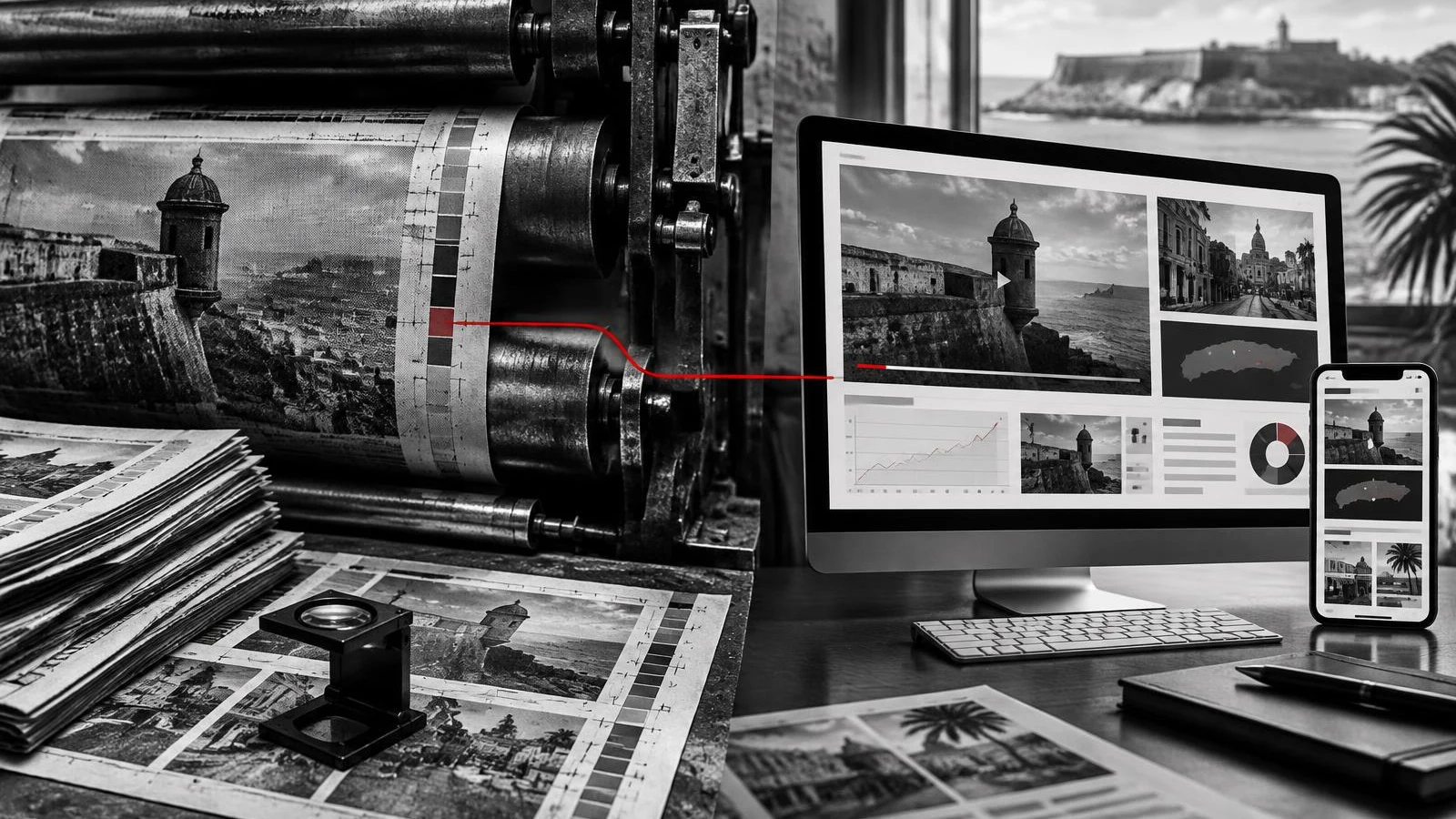
A transformation that has been unfolding before our eyes for years.
The announcement that El Nuevo Día and Primera Hora will stop publishing their print editions and move to a 100% digital model starting Monday, September 28 marks a historic moment for Puerto Rico's media. Not because the country has only now discovered that it consumes information digitally, but precisely because it confirms a transformation that has been unfolding before our eyes for many years.
For those of us who grew up with a newspaper on the table, the news inevitably carries an emotional dimension. For generations, the print edition was much more than a communications medium: it was part of a routine, a physical record of the day and, over time, part of Puerto Rico's collective archive.
But the way we receive information changed long ago. The phone replaced many of the functions once spread across the newspaper, television, radio, phone book, map, camera, calendar and even the shopping mall. Audiences did not stop consuming information. They changed where, when and how they consume it.
And brands, media outlets and agencies like ours have had to evolve alongside them.
+
A history of evolution that did not begin today
Looking at the history of Grupo Ferré Rangel helps put this announcement in perspective. In 1945, Luis A. Ferré acquired El Día, then a regional newspaper based in Ponce. In 1970, Antonio Luis Ferré moved the operation to San Juan, and the publication was reborn as El Nuevo Día, serving all of Puerto Rico. Nearly three decades later, in 1997, something happened that feels particularly significant today: El Nuevo Día launched its digital presence as El Nuevo Día Interactivo, endi.com, in the same year Primera Hora was born.
That was in 1997. Long before the iPhone. Before Facebook. Before YouTube, Instagram, TikTok and modern smartphones. In other words, these brands' digital transformation did not start with this week's announcement. It has been developing for nearly three decades.
In 2011, Grupo Ferré Rangel created GFR Media, consolidating El Nuevo Día, Primera Hora and other brands and platforms under a single media structure. Viewed this way, moving now to fully digital publishing looks less like a sudden break and more like the next stage in an ongoing technological evolution.
+ Archive / History
Decades telling Puerto Rico's story.
The evolution of El Nuevo Día can also be seen in its front pages. Design, photography, technology and the way information is presented change, but each edition documents a moment in Puerto Rico's history. These front pages, spanning more than five decades, help put the magnitude of this new transition into perspective.
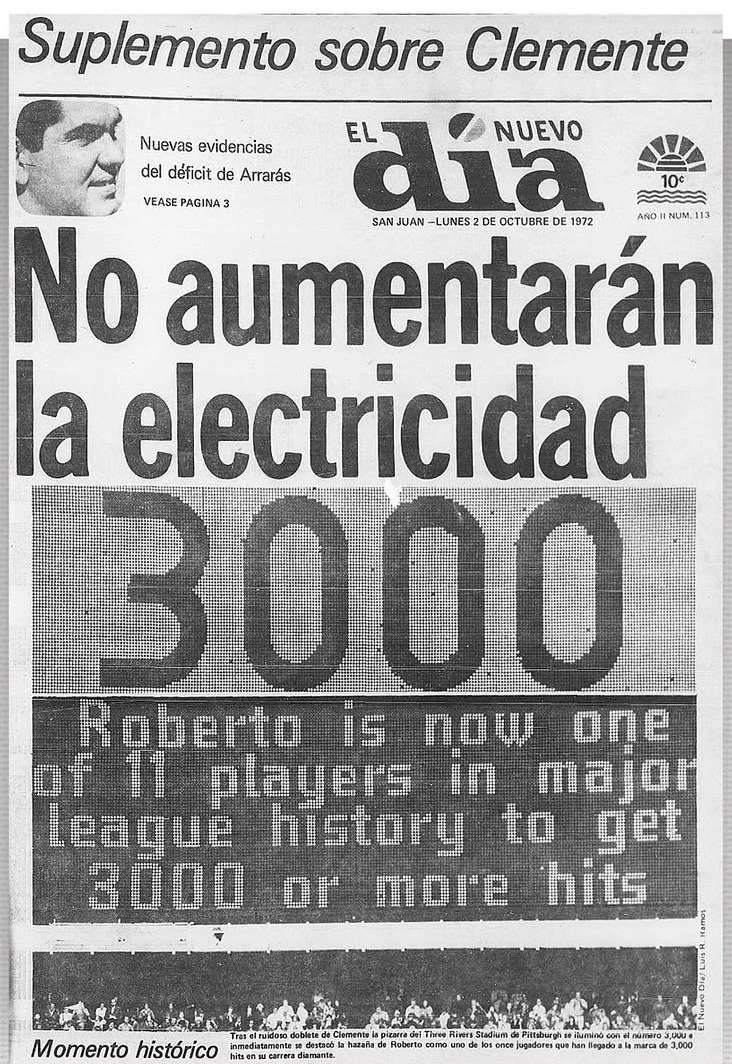
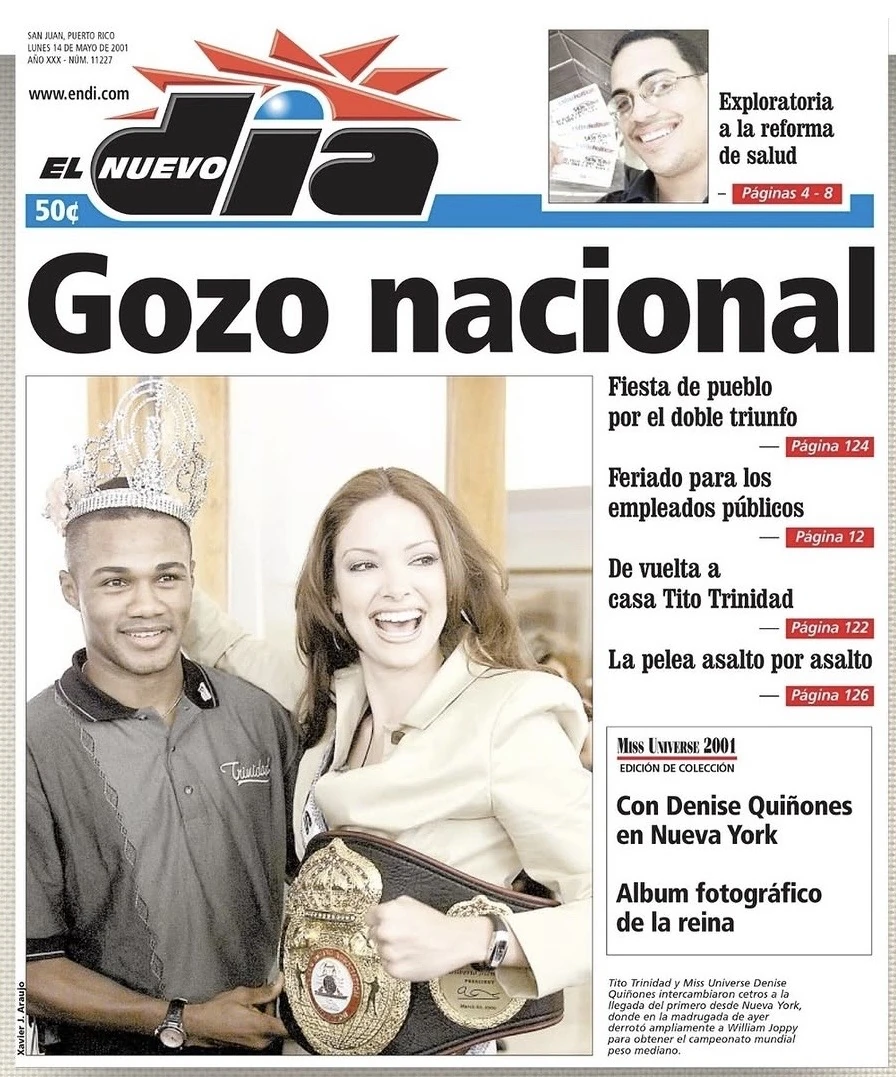
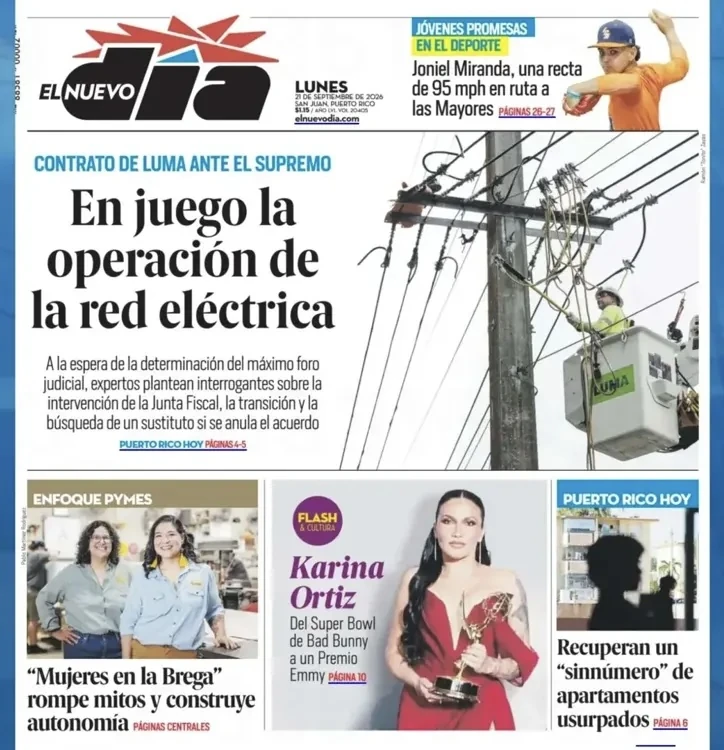
Selected front pages of El Nuevo Día. Images from GFR Media.
+
The audience had already made the transition
Perhaps the most important fact behind all of this is not in a printing press. It is in people's pockets. According to GFR Media's statement, citing the PR Digital Trends Study 2026, 98% of Puerto Ricans own a cell phone and 95% have access to the internet and digital media.
GFR also reported that El Nuevo Día reaches more than 3.4 million monthly unique users and Primera Hora more than 2.8 million. In the cited study, 59.4% of readers indicated a preference for accessing elnuevodia.com and 58.3% for primerahora.com. Both platforms also recorded double-digit growth compared with 2025.
Those numbers help explain the decision. Consumers had already moved. They did so through smartphones, social media, streaming, podcasts, short-form video, websites, apps and notifications. And this is not a phenomenon unique to Puerto Rico.
The Reuters Institute's Digital News Report 2026 found that, averaged across 48 markets, social media and video platforms are already used by 54% of respondents as a news source, surpassing even media outlets' own websites and apps, at 51%. Some 77% consume some form of online news video weekly. The same study notes that print newspapers, radio and television have experienced double-digit declines in weekly news use since 2013 in almost every market analyzed.
This does not mean television, radio or the press have lost their value. It means attention has fragmented and shifted.
+ The audience has already changed
The news lives in your pocket.
98%
owns a cell phone
95%
has internet access
3.4M+
monthly unique users of El Nuevo Día
+
It is not just moving from paper to a screen
This may be the most interesting point. Digitizing a newspaper does not mean taking exactly what used to be printed and placing it on a website. The real change happens when the outlet begins to take advantage of capabilities paper never had: immediate updates, video, audio, participation, personalization, databases, search tools, links, interaction, newsletters, streaming and formats developed specifically for different platforms.
That is precisely part of what GFR Media is announcing. Its statement notes that the new model will expand its reach, update news in real time, produce more video stories and deepen audience interaction. It also retains El Nuevo Día's ePaper as a digital continuation of the traditional newspaper experience.
New digital products are also on the way: video podcasts, specialized business content, digitized legal notices, loyalty programs, social experiences and new tools. That is much more interesting than simply saying that “print is over.” What is happening is a change in the delivery medium.
+ Evolution of the medium
The format changes. The story continues.
Papel
A daily print edition
Digital
Websites and continuous access
Intelligent digital
Data, automation and AI
+
And now comes another transformation: artificial intelligence
As media outlets finish adapting fully to mobile, video and social media, another transformation has already begun. Artificial intelligence is once again changing how people search for, discover, summarize and consume information.
The Reuters Institute found that the use of AI chatbots to access news rose globally from 7% to 10% in one year and reaches 16% among people under 35. It remains considerably lower than social media, websites or video, but its growth introduces a new intermediary between content and audiences.
Now someone can ask ChatGPT, Gemini or another system a question and receive a synthesis built from multiple sources without necessarily starting their journey by visiting a website directly. For media outlets, that presents another challenge.
The website remains essential, but it is no longer the only destination. Content needs to exist in a way that allows it to be distributed, found, indexed, cited, turned into video, shared on social media and delivered to people across multiple digital experiences.
GFR itself is already experimenting in that direction. Among the announced products is Shop+ from Shop.pr, a feature that will use artificial intelligence to help consumers plan purchases instead of manually searching for products and shopping circulars. We are not just seeing the transition from print to digital. We are entering the transition from digital to intelligent digital.
+ Intelligent digital
One story. Many ways to find it.
+
Content remains the asset
There is, however, something technology does not eliminate: the need for trustworthy content. In fact, the more information platforms, creators and artificial intelligence systems generate, the more valuable sources capable of investigating, verifying, contextualizing and documenting events may become.
The same Digital News Report 2026 reveals an interesting paradox: consumption through platforms and AI is increasing, but so are concerns about misinformation and trust. That creates an opportunity for established media outlets.
The format changes. The journalistic role does not necessarily have to. GFR makes a similar point in its announcement: its journalistic mission remains, while the way stories are produced and distributed changes.
+
For brands, the lesson is also quite clear
From a digital advertising and marketing perspective, this moment also offers an important lesson. Audiences do not wait for companies to be ready to adopt a technology. They simply move.
We saw it when attention began shifting from print to websites. Then to social media. Then to mobile, video, streaming and creators. Now we are watching AI begin to integrate into search, advertising, customer service, commerce and information consumption.
That is why a brand should not only ask, “Does this medium still work?” It should also ask, “Where is our audience today, and how do they want to engage with us?”
That means thinking about fast, well-structured websites, content designed for multiple formats, measurable digital campaigns, search, social media, video, e-commerce, data, CRM, automation and, increasingly, artificial intelligence. Our article on AI in Meta Ads and Google Ads explores how this new stage is already transforming advertising.
In our own experience working for years with organizations in media, real estate, education, consumer goods and other sectors, we have seen that digital transformation rarely happens through a single platform. It happens when strategy, technology, content, data and user experience begin working together.
Not because every new technology should be adopted automatically. But because systematically ignoring changes in behavior usually ends up costing far more than learning how to work with them.
+
A transformation we have also had the privilege of supporting
For us at Alterno, this transformation also holds special meaning. Since 2010, we have had the privilege of collaborating with GFR Media and various companies and platforms within the Grupo Ferré Rangel ecosystem on digital strategy, social media, audience research, web development, technology and advertising projects.
One of those early collaborations was with SAL!, the food and dining platform that lived at sal.pr for years and whose content is now part of El Nuevo Día's Gastronomía offering. For several years, we handled social media management, promotion and digital strategy for the brand and initiatives such as the SAL! Awards, at a time when social platforms were beginning to play an increasingly important role in the relationship between media outlets, audiences and advertisers.
SAL!'s own journey, from a standalone food and dining platform within GFR's digital ecosystem to El Nuevo Día's current Gastronomía offering, is another small example of how digital products evolve alongside audiences and platforms.
We also had the opportunity to work on audience research and analysis projects for Magacín, focused on gaining a deeper understanding of who was using its digital platforms and how that audience behaved. By analyzing website traffic, content consumption and social media behavior, we developed user persona studies that helped identify specific characteristics of its digital audience, including segments with high purchasing power. Those insights supported better decisions about content, digital experiences and advertiser opportunities.
This experience illustrates an important difference between publishing online and truly operating digitally: the ability to understand audience interaction through data. Analyzing journeys, consumption habits and signals of interest makes it possible to turn a content platform into a source of continuous learning, something traditional print could never offer with the same precision.
Our collaboration has also extended to other divisions and companies within the Grupo Ferré Rangel ecosystem. For Kingbird Property Management, we developed its website and defined the visual style used across its social media platforms, helping build a digital presence aligned with the professional profile of its real estate operation.
For NAI Puerto Rico, we developed its business website with integrations into its systems and CRM, connecting the company's public presence with its real estate infrastructure and internal management. We have also collaborated on its digital marketing strategy, SEO and digital media.
More recently, we had the honor of working on the complete redesign of Grupo Ferré Rangel's corporate website, developing a modern, dynamic and interactive corporate experience that presents its history, leadership, various business divisions and more than a century of business transformation.
Looking back, many of these projects have something in common: understanding how technology can help an organization get to know its audiences better, improve its platforms and find new ways to connect with them. That is precisely why we see this new stage for GFR Media not simply as the end of a format, but as another evolution within a much longer history of innovation.
Conoce nuestros proyectosWe are deeply grateful for the trust and so many years of collaboration with GFR Media and Grupo Ferré Rangel. It has been a privilege to contribute across different stages, platforms and projects, and we wish them every success in this new, fully digital chapter. At Alterno, we will, as always, remain available and excited to continue collaborating on projects of this scale with an organization that has played such an important role in Puerto Rico's business and media history.
The final print issue of Primera Hora is scheduled for Thursday, September 24, and El Nuevo Día's for Sunday, September 27. GFR has conceived them as commemorative editions to honor the craft and the generations of people who made it possible for the newspaper to reach homes across Puerto Rico every day.
It is an important closing chapter. But it is not the end of El Nuevo Día or Primera Hora. It is a change of platform.
And if these brands' own history demonstrates anything, from El Día to endi.com and now a 100% digital operation, it is that evolving can also be a way to preserve a mission.
Technology will keep changing. Screens will too. Artificial intelligence is arriving now, and something we have not yet anticipated will surely follow. What matters will be continuing to do what brands that survive these changes have always done: understand people, recognize where their behavior is heading and be willing to evolve with them.
As we shared in our look back at Alterno's 15+ years, evolving has stopped being something that happens every so often and has become part of the job.
The format changes. The mission can remain.
+ Referencia
Fuentes
- El Nuevo Día / GFR Media, “El Nuevo Día y Primera Hora serán 100% digitales”. Official transition announcement and primary source for dates, scope and productsanunciados.
- Grupo Ferré Rangel, Historia. Institutional timeline of El Día, El Nuevo Día, Primera Hora and the creation of GFRMedia.
- GFR Media, Sobre GFR Media. Perfil institucional y contexto sobre la estructura de medios creada en 2011.
- Sales & Marketing Executives Association of Puerto Rico, PR Digital Trends Study2026. Datos sobre acceso a internet, uso de celulares y hábitos digitales en Puerto Rico.
- Reuters Institute, Digital News Report 2026: Executive Summary. Research on news consumption, video, social platforms and intelligenceartificial.
- WAPA / NotiCentro, “Fin de una era: El Nuevo Día y Primera Hora dejarán de publicar sus versiones impresas”. Cobertura secundaria del anuncio y de las fechas finales de las ediciones impresas.
Tags
Topics in this article.
Let's talk
Is your brand ready for its next digital chapter?
We can help you turn shifts in audiences, technology and media into a clear digital strategy built to evolve.
REQUEST A PROPOSAL +Conversation +
Comentarios.
0 published
Your perspective helps this conversation grow. Share a comment, a question or your experience related to this article, we're listening.
Be the first to comment.
Keep reading
More from the blog.
News · September 2026
15+ Years of Alterno: A Story of Ideas, Change, and Transformation
Alterno Agency celebrates 15+ years of history and transformation: a look back at its ideas, clients, changes, technology, and artificial intelligence since 2009, and a look ahead to its future.
Read the article +Education · Junio 2026
AI in Meta Ads and Google Ads: the new era of media planning and optimization
How artificial intelligence is transforming media planning, buying, and optimization in Meta Ads and Google Ads.
Read the article +Services · Marzo 2026
Beyond the website: we develop custom platforms and digital solutions
We develop custom platforms, APIs, databases, dashboards, and integrations that connect websites, CRM, POS, and other systems to solve real business needs.
Read the article +
+ Ideas that keep moving
Get the next article.
Creativity, marketing, digital advertising, technology and artificial intelligence, straight to your inbox.
Let’s work together